A workflow can produce the right answer and still be unsafe to deploy. Consider an AI-powered customer service workflow handling refund requests. The model correctly understands that a customer qualifies for a refund, but during execution, it retrieves the wrong transaction, calls the refund API twice after a timeout, or processes an amount that should have required human approval. These breakdowns show why dedicated AI security testing must be prioritized alongside functional validation; when models interact directly with backend infrastructure, unvetted actions quickly become critical vulnerabilities.
The language model did its job. The workflow failed. This is why production readiness cannot be determined by prompt testing or model accuracy alone. Modern AI applications increasingly combine models with retrieval systems, APIs, business rules, agents, databases, memory, and human approval points. Each component may work independently while the complete workflow breaks under real operating conditions. AI workflow testing validates that these connected systems perform correctly, safely, and consistently before they are exposed to real users and production data.
What Is AI Workflow Testing?
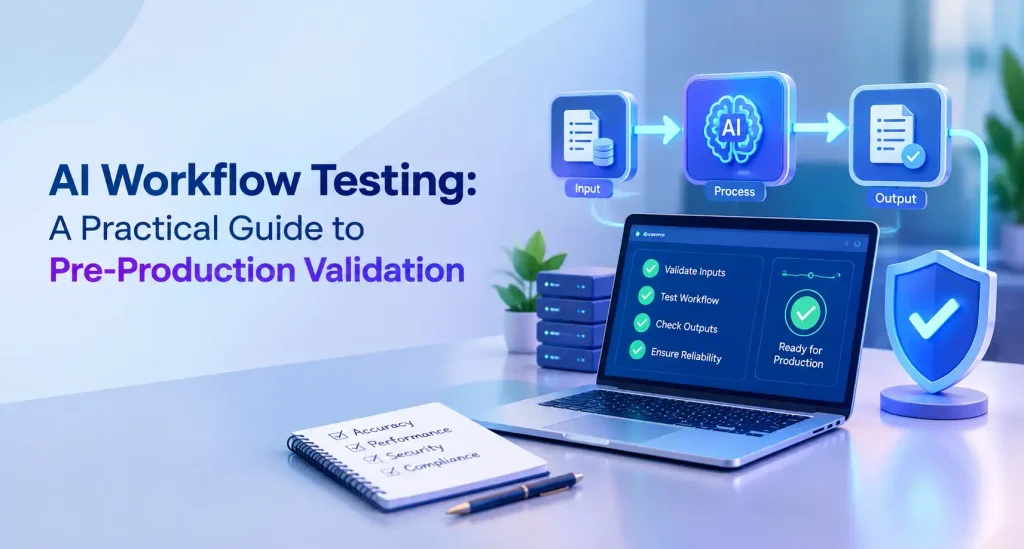
AI workflow testing is the systematic validation of an AI-enabled process from initial input through final outcome. Instead of asking only, “Did the AI generate an acceptable response?” testers examine the complete execution path:
Input → context retrieval → model or agent decision → tool selection → API execution → state update → downstream action → final result
Depending on the application, the workflow may also include multiple agents, approval gates, fallback models, databases, external services, and asynchronous processes. This makes AI workflow validation fundamentally different from testing an isolated model. Suppose an AI sales assistant receives the request:
“Identify customers whose subscriptions expire this month and prepare renewal emails for them.”
A successful workflow has to do much more than write good emails. It needs to identify the correct customer records, apply the correct date filters, retrieve appropriate account information, avoid restricted data, generate accurate drafts, save them to the intended location, and avoid sending anything unless explicitly authorized. Testing only the generated email would miss most of the real failure surface.
Start With the Business Outcome
The first step in AI workflow testing is defining what successful execution actually means.
Teams often begin with model metrics such as response quality or semantic similarity. Those metrics can be useful, but they do not necessarily indicate whether the workflow completed the business task correctly.
For every important workflow, define observable acceptance criteria. A claims-processing workflow, for example, might require that:
- The correct claim is identified.
- Required documentation is checked.
- Missing information triggers clarification rather than assumption.
- Policy rules are applied correctly.
- High-value claims are routed for human review.
- No unauthorized payment action occurs.
- The final system state reflects the reported outcome.
These criteria turn an open-ended AI interaction into something you can test systematically.
Test Components Before Testing the Full Workflow
End-to-end testing is essential, but debugging becomes difficult if every failure is discovered only at the workflow level. Break the system into testable components first.
- For a retrieval-augmented workflow, validate whether the retrieval layer returns the right documents.
- For an agent, validate tool selection and argument generation.
- For an external API, test expected and unexpected responses.
- For a routing layer, confirm that requests reach the correct model, agent, or approval process.
Then test how those components behave together. This layered approach becomes particularly important for autonomous systems. AI agent testing must cover more than final responses because agents can plan tasks, use tools, maintain state, and perform actions.
A deeper technical framework for testing autonomous AI agents shows why trajectory, tool-use, memory, orchestration, and guardrail validation become necessary once AI systems move beyond simple question-answering. The broader principle applies equally to AI workflows: validate the pieces, then validate their interactions.
Test the Workflow Path, Not Just the Final Answer
Non-determinism makes AI systems unusual from a QA perspective. Two workflow executions may reach the same valid result through slightly different paths. That does not mean every path should automatically be accepted.
Testers should therefore examine observable execution traces such as:
- Which data sources were accessed?
- Which tool was selected?
- What parameters were sent?
- Which branch was taken?
- Was an approval checkpoint triggered?
- How many retries occurred?
- What state changes were made?
- Did the workflow stop when its objective was achieved?
Imagine an employee-access workflow in which the AI eventually produces the correct permission level but skips a mandatory manager-approval step. The final result might appear correct, but the workflow must fail validation because the path violated policy. For regulated or high-impact processes, path correctness can matter as much as output correctness.
Validate Tool Use and External Integrations
Tools are among the highest-risk parts of AI-enabled workflows because they convert model decisions into actions. An AI system may query a CRM, create support tickets, send emails, update databases, generate invoices, initiate transactions, or interact with cloud infrastructure.
AI workflow validation should confirm both whether the correct tool was selected and whether it was called correctly. Test cases should cover incorrect parameters, unavailable services, malformed API responses, authentication failures, timeouts, rate limits, duplicate requests, partial success, and conflicting results.
Consider a workflow that creates shipping labels. If the shipping API times out after successfully creating a label but before confirming success to the AI application, the workflow must not automatically create another label without first checking whether the original action completed.
That is an idempotency problem, not a language problem. These integration-level failures are exactly why AI workflows need conventional software testing disciplines alongside model evaluation.
Test Branching and Exception Handling
Real workflows rarely follow one perfect path. Customers provide incomplete information. APIs fail. Retrieved documents conflict. Required fields are missing. An agent may not have enough confidence to continue. Pre-production testing needs to deliberately create these situations.
For each major workflow, test the happy path along with ambiguous requests, missing data, contradictory data, invalid tool output, unavailable integrations, permission failures, and unexpected user behavior. A reliable workflow should know when not to proceed.
Suppose an AI purchasing assistant receives: “Order the same laptops we purchased last time.” If there are multiple previous laptop orders, the correct behavior may be to request clarification rather than arbitrarily selecting one. The ability to stop, clarify, retry safely, or escalate is part of functional correctness.
Simulate Downstream Failures
One of the most valuable forms of pre-production testing is fault injection. Instead of assuming every dependency will behave normally, deliberately make systems fail. Return HTTP 500 errors from APIs. Introduce latency. Supply malformed JSON. Remove an expected field. Make a database temporarily unavailable. Return contradictory information from two tools.
Then observe what the workflow does. Does it retry indefinitely? Does it silently substitute fabricated information? Does it tell the user that an operation succeeded when it actually failed?
Does it escalate to a human? Does it leave the system in a partially completed state? Resilience testing reveals whether the workflow remains predictable when the environment becomes unpredictable.
Security Testing Cannot Be a Separate Afterthought
As soon as AI workflows access external data or action-capable tools, the security surface expands significantly. OWASP highlights risks including direct and indirect prompt injection, tool misuse, excessive permissions, excessive autonomy, data exfiltration, and memory manipulation in LLM and agentic systems.
That means AI security testing should be part of pre-production workflow validation rather than an isolated assessment just before release. Tests should attempt scenarios such as:
- Malicious instructions embedded in retrieved documents
- Prompt injection arriving through emails or websites
- Attempts to make an agent call unauthorized tools
- Requests to access another user’s records
- Manipulated tool responses
- Attempts to bypass approval requirements
- Sensitive information appearing in logs or outputs
- Destructive actions requested without explicit confirmation
OWASP specifically identifies excessive agency as a risk when AI systems receive more functionality, permissions, or autonomy than their task requires. Testing should therefore confirm not only that guardrails exist, but that the underlying systems enforce authorization. A prompt telling an agent not to delete data is not a substitute for restricting its delete permission.
Build a Regression Suite Around Real Failure Modes
One successful test run tells very little about long-term reliability. Models change. Prompts change. Retrieval indexes change. APIs evolve. Business rules are updated. Tool descriptions are rewritten. Each change can affect workflow behavior elsewhere.
A mature AI workflow automation testing strategy should maintain a regression suite containing normal workflows, boundary conditions, ambiguous inputs, known historical defects, tool failures, adversarial inputs, permission tests, and business-critical scenarios. A useful principle is simple: Every meaningful production defect should become a permanent test case.
Over time, the regression suite becomes a record of what the system has learned not to do.
Automated execution in CI/CD can then identify regressions before a changed prompt, model, integration, or orchestration rule reaches production.
Use Production-Like Validation Without Production Consequences
Some workflow behaviors only emerge when systems encounter realistic data volumes, integrations, and user patterns. That does not mean teams should first discover them in production. A useful strategy is shadow testing.
A new workflow version can process realistic requests without being allowed to perform consequential actions. Teams can then compare its decisions with the existing workflow or expected outcomes. For example, an AI support workflow may determine whether to issue refunds in shadow mode while the real production process still requires human handling.
Teams can study disagreement rates and failure patterns before allowing the AI to execute refunds itself. NIST notes that pre-deployment evaluations are valuable but inherently occur in controlled environments, while continued monitoring after deployment remains important because real-world conditions and AI non-determinism can produce unexpected behavior.
Pre-production validation should therefore reduce risk substantially, not create a false assumption that testing ends at release.
Define Release Gates, Not Just Test Reports
The final step is converting testing results into deployment decisions. Teams should define measurable release criteria around areas such as:
- Task completion rate
- Critical workflow failure rate
- Tool-selection accuracy
- Parameter accuracy
- Policy-compliance rate
- Unauthorized-action rate
- Escalation accuracy
- Recovery from dependency failures
- Security-test pass rate
- Latency and cost thresholds
Not every metric deserves the same weight. A slightly verbose response may be acceptable. A workflow that occasionally sends information to the wrong account is not. Release gates should reflect business impact rather than treating every defect as equivalent.
Establishing Reliable Release Pipelines
Treating intelligent software like an opaque black box exposes organizations to legal liabilities, operational overhead, and damaged user trust. Capabilities remain dependable only when supported by structured quality engineering.
Moving verification from late manual spot-checks to continuous evaluation suites helps teams confirm system behaviors against repeatable standards. Implementing structured AI workflow automation testing turns probabilistic uncertainty into stable, predictable execution, allowing modern enterprises to scale autonomous pipelines with complete operational confidence.
Frequently Asked Questions (FAQs)
Q1: Why isn’t prompt evaluation enough to ensure production safety?
A: Evaluating prompts measures linguistic output in isolation. It misses backend execution failures like broken parameter serialization, unhandled API timeouts, incorrect database writes, and policy violations across downstream enterprise infrastructure.
Q2: How does AI workflow testing differ from AI agent testing?
A: AI agent testing evaluates autonomous planning, tool choice, and memory state. Workflow testing validates the entire multi-system path, including data routing, transactional rollbacks, human approval checkpoints, and external API integrations.
Q3: When should teams use shadow testing instead of synthetic staging?
A: Use synthetic staging early for fault injection and security stress testing. Deploy shadow testing in late pre-production to process live traffic with write actions muted, exposing real-world edge cases and latency spikes.
Q4: How do you prevent multi-agent workflows from entering infinite execution loops?
A: Implement hard architectural bounds independent of the model’s reasoning. Set strict iteration caps, enforce execution timeout budgets, and use pattern-detection rules that trigger human escalation whenever recurring parameter loops appear.
Q5: What defines an actionable release gate for an AI-enabled business process?
A: Tie release gates directly to business risk. Enforce zero tolerance for critical failures like unauthorized actions, data leakage, and failed human escalations, while accepting defined statistical variance for conversational tone.