Your traffic is growing. Search impressions are healthy. Social content is getting seen. Campaigns are generating clicks. Yet enquiries remain inconsistent.
Visitors arrive, browse, and leave. Sales teams question lead quality. Conversion rates barely move.
The usual response is to increase brand visibility further. Publish more. Advertise more. Rank for more keywords. Enter another channel. But sometimes visibility is no longer the problem. The problem is what happens after people notice you.
A brand can be easy to find and still be difficult to choose. And that gap between being seen and being selected is where many growth strategies quietly break down.
Visibility Does Not Equal Preference
Visibility tells you that people encountered your brand. It does not tell you whether they understood it, trusted it, remembered it, or preferred it over alternatives. That distinction matters because brands often diagnose a conversion problem as an awareness problem.
If your audience already knows you exist, buying more reach may simply send more people into the same weak experience.
A useful brand evolution strategy therefore needs to answer more than:
“How many people saw us?”
It should ask:
“Were the right people seeing us, and did they find a compelling reason to move forward?”
This is where brand visibility has to be connected with positioning, relevance, trust, and commercial intent.
You May Be Visible to the Wrong Audience
A brand can attract significant traffic and still generate little meaningful demand. This happens when visibility is measured mainly by volume. High impressions, growing followers, more clicks, and stronger keyword rankings all look positive on a dashboard. But they do not necessarily tell you whether the audience has buying intent.
A website attracting 40,000 visitors a month may contribute less revenue than one attracting 4,000 relevant decision-makers. The difference is intent.
Broad informational traffic can bring researchers instead of buyers. Social content can travel widely because it is entertaining, not because it reaches the right prospects. Paid campaigns can optimize for low-cost clicks while quietly weakening lead quality.
A stronger question is:
Whose attention are we earning?
Visibility becomes commercially useful only when it reaches people with a genuine reason to consider what you sell.
Your Positioning Is Too Generic
Many brands believe they have strong positioning because they have a polished tagline. They do not.
Statements such as:
“Creating meaningful experiences.”
“Driving digital transformation.”
“Building future-ready solutions.”
“Helping businesses grow.”
…sound acceptable but do very little strategic work.
Competitors can make the same claims.
Strong brand positioning should help customers understand where you fit, who you are for, which problem you solve particularly well, and why they should categorize you differently from other options.
Your brand identity and brand positioning should create mental distinction, not just visual consistency. If visitors cannot quickly explain what makes your business meaningfully different, greater visibility may simply make your sameness more visible.
Your Messaging Creates Interest but Not Confidence
Attention and buying intent are not the same thing.
A strong campaign can generate curiosity. A good article can bring visitors in. A smart social post can increase engagement. But once someone starts evaluating your business, the questions become more specific.
They want to know:
- What exactly do you do?
- Can you solve my problem?
- Have you done it before?
- Why is your approach different?
- What evidence supports your claims?
- What happens if I choose you?
This is where many brands lose momentum. Their messaging remains broad when the buyer needs specificity.
Websites keep talking about innovation, transformation, and possibilities when the customer wants proof, process, relevance, and outcomes. Conversion rarely fails because a button did not say the right thing. It often fails because the visitor still has too many unanswered questions before reaching the button.
Your Brand Promise Falls Apart After the Click
Imagine discovering a company through a polished campaign.
The advertising looks premium. The messaging sounds strategic. The creative builds confidence.
Then you click through and the website feels dated. The page takes too long to load. The service descriptions are vague. Case studies say very little. The contact journey feels unnecessarily complicated. The brand has created one expectation before the click and delivered another afterwards.
That inconsistency matters.
Good website conversion optimization is not only about CTA placement, forms, or landing-page layouts. It is also about coherence. A premium brand should feel premium throughout the journey. A brand promising simplicity should make it easy to understand, explore, and enquire.
A business claiming expertise should demonstrate expertise. Customers may not consciously identify every inconsistency, but they notice when something feels off. And uncertainty usually reduces conversion.
You Have Not Built Enough Trust
Most brands ask buyers to believe too much. They say they are trusted. Experienced. Results-driven. Industry-leading. But where is the proof?
Trust is built through evidence such as:
- specific case studies,
- measurable results,
- strong testimonials,
- credible clients,
- clear processes,
- third-party recognition,
- specialist expertise,
- original thinking.
The more expensive or complex the purchase, the more proof the buyer will expect. This is particularly important in B2B.
A six-figure engagement cannot rely on the same trust signals as a low-risk consumer purchase. Yet many websites still expect a logo strip, a few generic testimonials, and a “Talk to Us” button to carry the entire conversion journey.
That is rarely enough.
The Offer Itself May Be the Problem
Not every conversion issue is a website problem.
Sometimes the website is clear. The traffic is relevant. The audience understands the service. And people still do not buy. At that point, the offer deserves scrutiny.
Perhaps the service is too broad. Perhaps the value is difficult to justify. Perhaps pricing does not match perceived value. Perhaps the engagement requires too much commitment too early. Perhaps competitors offer an easier entry point.
This is where conversion rate optimization needs to move beyond page-level experimentation.
Changing a CTA is easier than changing an offer, which is why businesses often default to tactical fixes. But if customers understand what you sell and repeatedly decide not to buy it, button testing will not solve the real problem.
You Are Asking for Too Much, Too Soon
Many websites give visitors only one meaningful next step:
- Book a demo.
- Talk to sales.
- Request a proposal.
- Schedule a consultation.
That works for someone already close to purchase. It is a large jump for someone who discovered your brand thirty seconds ago.
Different visitors arrive with different levels of intent. Some are exploring a problem. Some are comparing approaches. Some are researching suppliers. Some are ready to shortlist vendors. A stronger conversion journey creates appropriate next steps for each stage.
That might include a case study, an assessment, a guide, a calculator, a product demo, a benchmark, or a consultation.
Conversion does not always happen in one step. Often, it is a sequence of smaller commitments that gradually reduce uncertainty.
Your Teams May Be Optimizing Different Versions of the Brand
Another issue appears when marketing functions operate in isolation.
SEO wants traffic. Paid media wants leads. Social wants engagement. Brand wants consistency. Sales wants opportunities. Each team may be performing well against its own targets. The customer, however, experiences all of this as one brand.
If an ad promises one thing, the website emphasizes another, and sales introduces a third proposition, the customer has to do the work of connecting everything.
A coherent strategy by a competent digital brand agency will align awareness, acquisition, positioning, experience, and conversion around the same core promise.
Without that alignment, growth becomes harder even when individual channels look successful.
Stop Measuring Visibility in Isolation
The biggest problem may simply be how success is being measured.
- Impressions.
- Reach.
- Traffic.
- Engagement.
- Keyword growth.
- Brand mentions.
These metrics are useful, but they are not the commercial outcome. The more important question is what happens after the initial exposure.
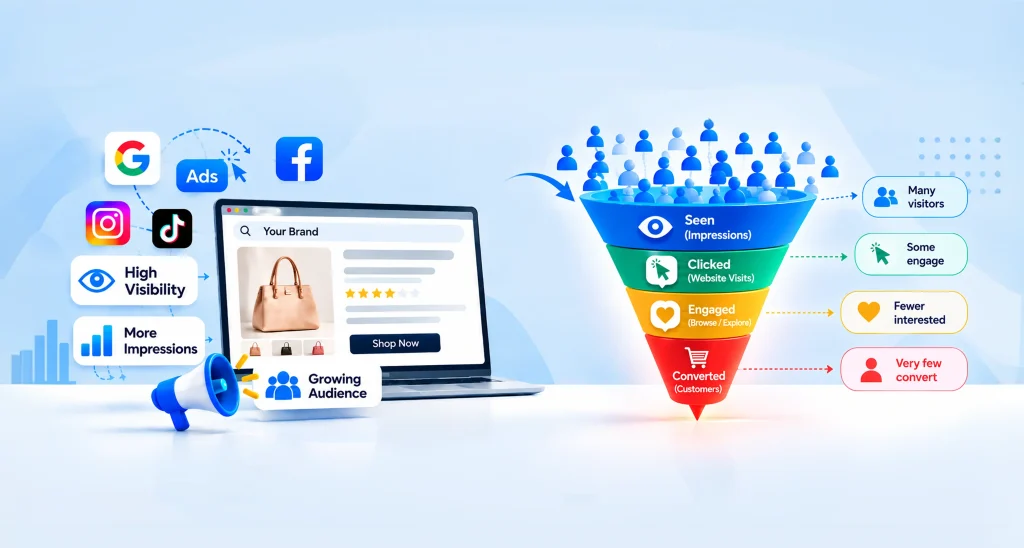
A useful funnel may look like:
Impression → Click → Engaged Visit → Consideration → Enquiry → Qualified Lead → Opportunity → Revenue
That sequence makes the problem easier to diagnose.
Strong impressions but weak clicks? Your relevance or messaging may be off.
Strong traffic but low engagement? The landing experience may not match expectations.
Healthy engagement but few enquiries? Trust, positioning, or offer design may be the issue.
Lots of enquiries but poor lead quality? Targeting may be too broad.
This is far more useful than simply concluding that the brand needs “more leads.”
The Real Problem Is Often Not Visibility
Many established brands do not suffer from a lack of attention. They suffer from a lack of distinction. They are visible without being memorable. Known without being preferred. Interesting without being convincing. Present without being commercially persuasive.
That is why growth often requires less obsession with reach and more attention to what happens after the reach has been achieved.
The real questions are:
- Are you attracting the right people?
- Is your positioning clear?
- Is your value easy to understand?
- Do you provide enough proof?
- Does the buying journey reduce friction?
- Does the offer justify action?
Because brand visibility can put you into the consideration set. It cannot guarantee that you stay there. The brands that convert are not always the brands people see most often. They are the brands people understand quickly, trust comfortably, and can justify choosing. That is where branding stops being a communications exercise and starts becoming a growth function!
FAQs
1. Why is my brand visible but not converting?
High visibility does not guarantee conversions. Weak positioning, low buyer intent, unclear messaging, insufficient trust signals, or friction in the customer journey can all prevent attention from turning into action.
2. How can brand visibility improve conversions?
Brand visibility supports conversions when it reaches the right audience and is backed by clear positioning, credible proof, relevant messaging, and an easy path to the next step.
3. What is the difference between brand awareness and conversion?
Brand awareness measures whether people know or recognize your brand. Conversion measures whether that attention leads to a desired action, such as an enquiry, sign-up, demo request, or purchase.
4. Can better brand positioning increase conversion rates?
Yes. Clear brand positioning helps buyers understand who you serve, what makes you different, and why your offer is relevant, which can reduce uncertainty during evaluation.
5. How does website conversion optimization support brand growth?
Website conversion optimization improves how visitors move from interest to action by reducing friction, strengthening trust, clarifying value, and making the next step easier to understand and complete.