Release cycles keep shrinking. Manual test suites can’t keep pace. The best software testing tools with automation close that gap by catching regressions, healing broken selectors, and generating tests faster than any human QA team can manage alone. This list covers five platforms worth a serious look in 2026, ranked by overall capability.
Why AI Automation Matters in Testing
Teams still running purely manual regression cycles lose days to repetitive work that generates no real insight. The shift toward automation-driven testing isn’t a trend, it’s a direct response to release schedules now measured in hours, not weeks. Every platform reviewed here treats AI as a structural part of the testing pipeline, not something bolted on as an afterthought.
The difference shows up in concrete ways. Self-healing selectors don’t break every time a developer renames a class; natural-language test authoring doesn’t require a scripting background; parallel execution cuts feedback loops down to minutes. Teams evaluating software testing tools with AI and automation should weight these capabilities above raw feature count.
1. Functionize
Functionize was built from the ground up as an AI-native testing platform, not a traditional framework with machine learning tacked on later. Founded in 2014 and based in Walnut Creek, California, the company has trained its AI on over eight years of enterprise data and more than 30,000 data points per page. That depth is what gives Functionize’s element recognition a 99.97% accuracy rate, and it’s what cuts flaky tests and maintenance load by 80%.
Non-technical team members can author and deploy tests up to 90% faster than traditional scripting allows. QA doesn’t stall waiting on engineers. When teams look for software testing tools with AI and automation that stretch across roles, Functionize’s combination of self-healing AI agents and plain-language authoring is worth sweating over the details. GE Healthcare reduced 40 hours of testing time to 4 hours using the platform, a 90% labor savings. McAfee saw testing times drop from hours to minutes across global markets. Functionize was named a Strong Performer in the Forrester Q4 2025 Wave Report on Autonomous Testing Platforms and holds over 60 enterprise clients, including Fortune 500 companies.
2. mabl
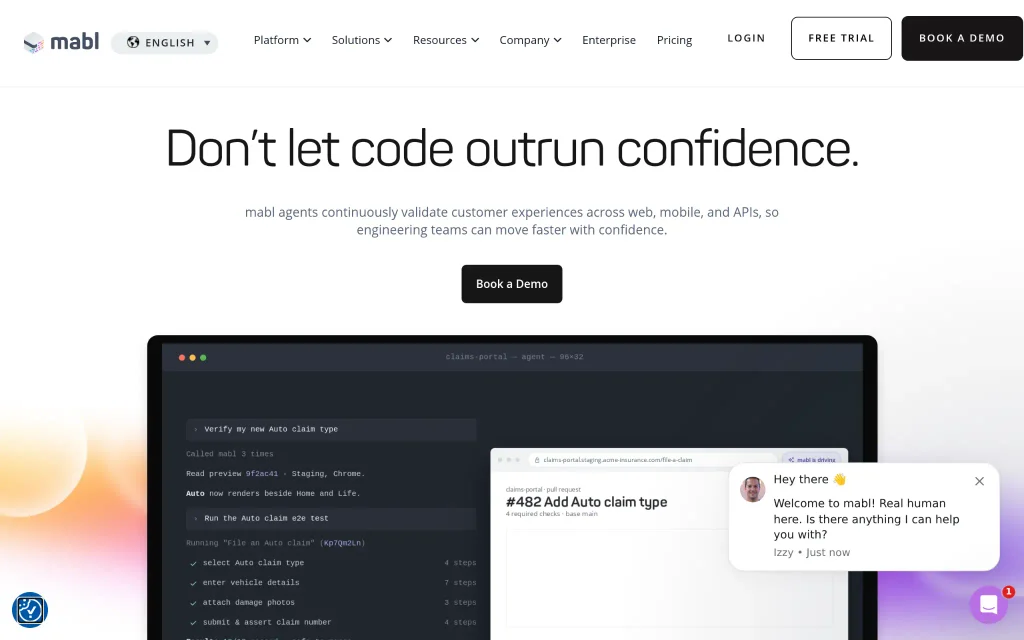
mabl launched in 2016 out of Boston with a clear focus: make test automation fast enough to keep pace with continuous delivery. The platform covers web, mobile, and API testing in one place, with low-code test creation and auto-healing at its center. Its multi-model AI – combining traditional machine learning with generative AI – supports the adaptive resiliency that reportedly cuts test maintenance by 85%.
CI/CD connection is a genuine strength here; mabl plugs directly into Azure DevOps, Jenkins, and GitHub Actions, and syncs with collaboration tools like Jira and Slack. Microsoft, Charles Schwab, and JetBlue are among its clients. And it’s earned a G2 Leader badge in Test Automation, plus the AI Breakthrough Award for Best AI-Based Solution for Engineering four times overall. Pricing is custom with no free plan, though a trial is available.
- Unified coverage across browser UI, API, mobile, accessibility, and performance
- Native CI/CD integrations including Jenkins and GitHub Actions
- Fortune Global 2000 client base including Microsoft and Charles Schwab
3. Sauce Labs
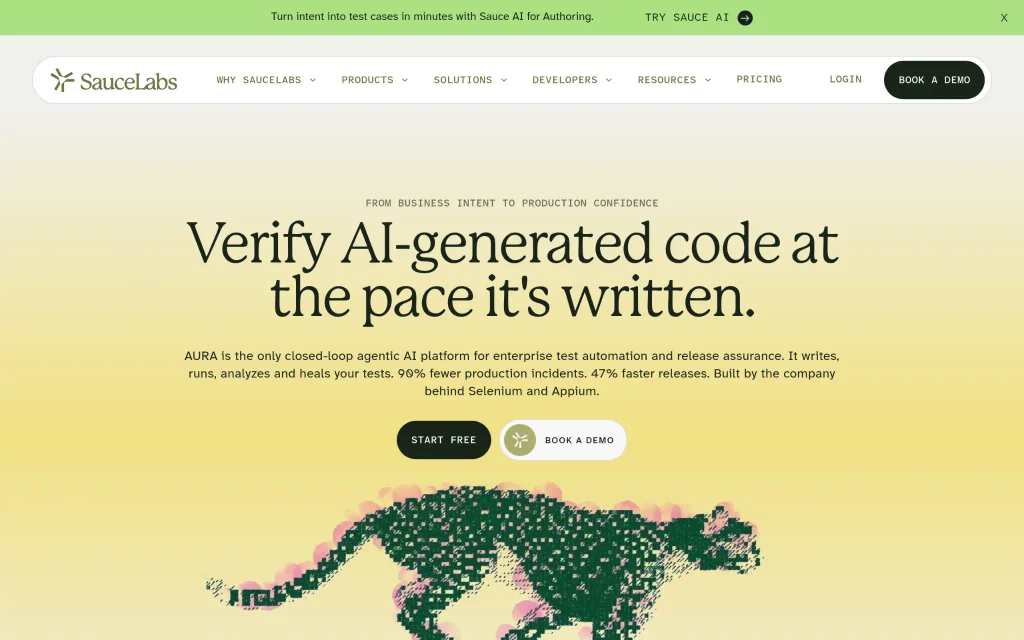
Sauce Labs has been running automated tests longer than most, the company was founded in 2008 by Jason Huggins, the engineer who created the Selenium testing framework. That heritage gives it deep credibility in automated testing standards. Today the platform handles web, mobile, and API testing at serious scale: 8 billion-plus tests executed, 300,000-plus active users, and 9,000-plus real devices in its device cloud.
The 2026 platform adds test authoring that auto-generates tests, plus AI-driven analytics for surfacing useful data across runs. Walmart, Bank of America, and Indeed rely on it. Its 2024 ARR hit $92.1 million, up from $68.6 million in 2023; that growth shows sustained enterprise adoption. Sauce Labs won the 2025 CODiE Award for Best Debugging and Testing Tool. Pricing isn’t publicly listed, but a free trial is available.
- 9,000-plus real devices plus 2,500-plus emulator and browser/OS combinations
- Test authoring and AI-driven run analytics
- Unified platform spanning web testing, mobile, error reporting, and visual testing
- Founded by the creator of Selenium, with deep open-source roots
- 2025 CODiE Award winner for Best Debugging and Testing Tool
4. Virtuoso QA
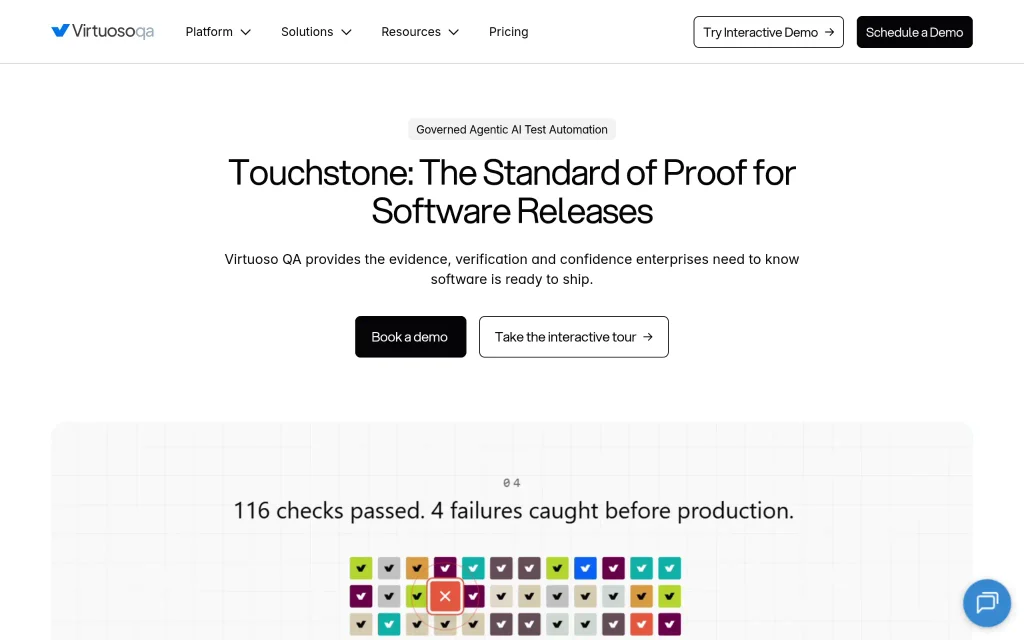
Virtuoso QA was founded in 2017 in London with an AI-native architecture from day one. The platform was designed around machine learning and natural language processing from the start, rather than retrofitting AI onto a legacy framework. That architecture makes it possible for QA engineers, developers, and business users to write tests in plain English, no scripting knowledge required.
The platform covers web testing, API testing, agentic testing, and composable test building blocks, along with self-healing tests and root-cause analysis on regressions. Clients report up to 85% lower test maintenance costs and 30 to 40% overall QA cost savings. Virtuoso QA earned a Strong Performer designation in The Forrester Wave: Continuous Automation Testing Platforms, Q1 2024 report. It is SOC 2 Type II certified and integrates with Jira, Jenkins, TestRail, GitHub, Azure DevOps, and BrowserStack.
- AI-native architecture built from the ground up with ML and NLP
- Plain-English test authoring accessible to QA, devs, and business users
- Up to 85% reduction in test maintenance costs per client reports
- Agentic testing and composable test building blocks
- SOC 2 Type II certified with 50-plus integrations
5. Selenium Testing
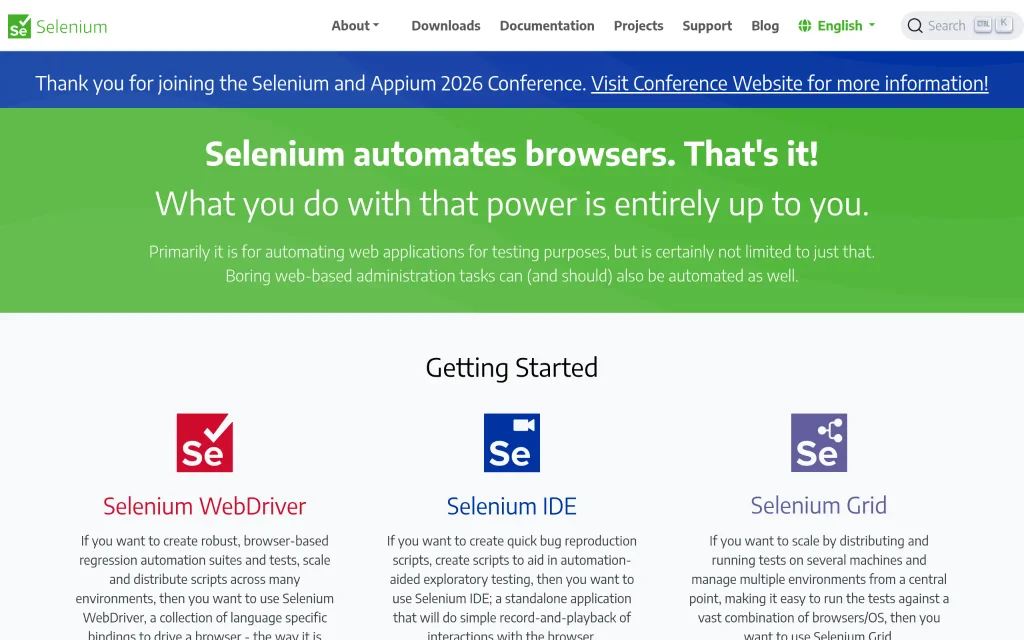
Selenium is the open-source backbone of automated browser testing. It started in 2004 at ThoughtWorks in Chicago as a JavaScript test runner and grew into the standard that most commercial platforms either extend or build on top of. The project is governed by the Software Freedom Conservancy and freely available under the Apache License 2.0.
Three tools make up the Selenium project. Selenium WebDriver is the main interface for writing cross-browser test instructions. Selenium IDE handles record-and-playback for quick browser automation. Selenium Grid distributes tests across multiple machines and environments simultaneously. There’s no commercial pricing and no vendor lock-in, which keeps Selenium attractive to teams with strong engineering capacity who want full control. But the upside of that flexibility comes with a real headache: setup, maintenance, and self-healing all fall to your own team.
- Three components: WebDriver, IDE, and Grid for distributed testing
- Free and open source under the Apache License 2.0
- Browser-agnostic WebDriver interface
- Annual community conference and active contributor ecosystem
- No commercial subscription required
Key Capabilities to Evaluate
Picking among the best software testing tools with automation means knowing which capabilities actually move a team’s workflow. A few areas matter most.
- Test maintenance overhead. Selector-based tests break constantly as UIs change. Platforms with genuine self-healing – where the AI finds the right element without a human rewriting the locator – cut that cost dramatically. Look for documented maintenance reduction figures, not marketing language.
- Test authoring speed. Teams that need QA input from non-engineers should prioritize natural-language or low-code authoring. Scripting-first workflows still require engineering involvement at every step, and that’s a bottleneck you’ll feel fast.
- CI/CD fit. A testing platform that doesn’t connect cleanly to the team’s pipeline creates friction. Native integrations with Jenkins, GitHub Actions, and Azure DevOps are table stakes for any DevOps-aligned team.
- Execution scale. Unlimited parallelization shortens feedback loops. Real-device coverage matters for mobile-heavy products. And teams scaling test suites across global markets need infrastructure that won’t slow them down when volume spikes.
- Open-source vs. managed. Selenium gives total control at zero licensing cost. Managed platforms like Functionize, mabl, Sauce Labs, and Virtuoso QA trade some of that control for maintenance, support, and AI capabilities most teams can’t easily build themselves.
Bottom Line
The right pick depends heavily on the team’s makeup and pipeline. Selenium suits engineering-heavy teams that want full control and no licensing cost. mabl and Virtuoso QA are strong for teams wanting low-code authoring without sacrificing CI/CD depth. Sauce Labs fits organizations running large-scale cross-browser and real-device coverage. Teams that prioritize AI-native architecture, non-technical test creation, and documented enterprise results will find the most relevant options at the top of this list.