A trading agent scans a news headline, decides to add exposure, and fires off a second order before the first request even receives a confirmation. The market barely has to shift. A duplicated instruction like this can produce a loss that the underlying strategy never planned for.
Automating the process shrinks the gap between a choice and its fallout.
Traders in Indonesia face another wrinkle: an overseas market open can land squarely outside their normal watching window. So AI trading agent risk management needs to function when nobody is at the screen, when the connection drops, or when the model returns something unexpected.
At Versus Trade, you can use a demo account to test trading strategies and examine platform behaviour before committing real capital. This virtual funds environment is a great way to practice.

AI Trading Bot Risk Management Starts Outside the Model
Generating a profitable forecast and getting permission to place a trade are two different things. An agent can spot a compelling setup even while the account sits at the edge of its risk budget.
Our write-up on building intelligent AI trading agent systems walks through the layers that connect data, models, and order execution. In between the proposed order and the trading connection, you can insert an independent risk management system that checks each request against a rulebook the agent has no power to edit.
That sort of architecture gives guardrails for AI agents a specific, concrete assignment:
- Reject orders outside approved symbols, sizes, and trading hours.
- Block extra exposure when account losses reach a set threshold.
- Stop new entries when prices, account data, or execution status become unreliable.
These safety controls let an operator manage risk in algorithmic trading without having to rely on artificial intelligence to do it. In the overall AI risk management picture, their job is to hold AI systems within limits even when a forecast looks convincing. A fixed, deterministic check is far easier to audit than a model’s explanation for why an exception felt justified.
Drawdown Needs an Account-Level Reference
A bot can tell you it booked several winning trades while, at the same moment, an open position is bleeding a much larger floating loss. Risk assessment that only counts closed results misses that slide entirely.
In this example, the max drawdown limit is a trailing equity threshold that stops the account from going down past its highest recorded equity level. Say an account climbs from $10,000 to $10,500. An 8% trailing threshold would trip at $9,660. That puts it $840 under the peak, even though the account sits only $340 below where it started.
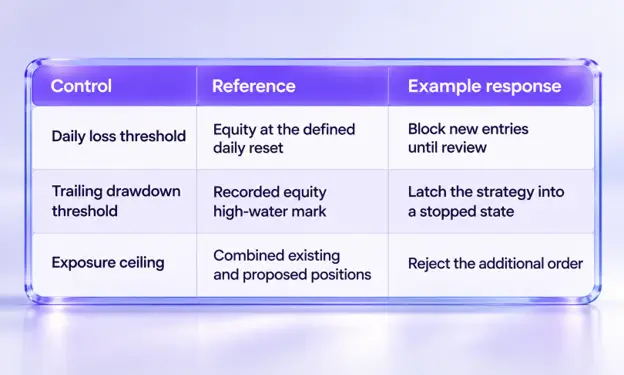
A daily loss limit works from a different baseline. Take a 2% threshold measured against $10,000 of equity at the day’s open. That would hit at $9,800. Both of these are design examples, not suggested configurations. Actual numbers hinge on your risk tolerance and the capital you have available.
Deposits and withdrawals need explicit treatment to avoid creating fake gains or hiding losses. The daily reset needs a named timezone too. Jakarta, Makassar, and Jayapura run on different clocks, and a broker server might operate in an entirely different one.
The risk management process has to spell out what happens when a breach occurs. A threshold triggers an action; it doesn’t guarantee a maximum loss. Gaps, slippage, and slow execution can push equity right past it.
A Demo Run Has to Include Deliberate Failures
A smooth simulation tells you very little about how trading operations will bounce back from a dropped connection. Faults deserve their own dedicated test scenarios.
The practice trading account gives you a virtual-funds environment to examine platform behaviour and test trading strategies.
During an agent rollout, that same space can reveal whether the surrounding software actually respects its permissions and obeys its stopping rules. The account itself doesn’t provide a custom agent’s independent risk controls. Those live in the implementation.
Backtesting against history can surface sensitivity to transaction costs, market volatility, and changing market conditions. Splitting evaluation into separate periods makes it harder to keep nudging an algorithm until it fits yesterday’s prices. There is a catch, though: a language model tested on old news might already know the outcome from its training data. Timestamping the inputs doesn’t wash away that contamination.
Forward demo account testing contributes observations that history can’t deliver. Logs reveal how the agent reacts to live market data, delayed responses, and the real sequence of order acknowledgements. Simulated fills still can’t tell you how future live execution will behave.
One valuable test involves cutting the connection on purpose right after an order goes out. On reconnection, the system checks account and order records first before deciding if another request is warranted. Without that check, a retry can double the intended exposure by opening another position or by increasing an existing one.
Real-time risk monitoring also leans on fresh account data. Risk detection becomes less reliable when the system relies on outdated account data. The suggested policy: if the latest equity reading isn’t available, block new exposure while keeping whatever exit monitoring still works. Missing account data must remain in an error state. If the unavailable position or loss data means no exposure or no loss, this could allow additional orders through.
A Kill Switch Needs More Than an Off Button
A trading bot kill switch only earns its keep when you define exactly what it covers. Switching off one process can still leave pending orders sitting at the server, plus another instance humming along on a virtual private server. A risk mitigation sequence can block new risk, ask to cancel outstanding entries, and apply a pre-agreed policy to existing positions. Every one of those actions needs a confirmation. A cancellation request that goes unanswered is still open exposure.
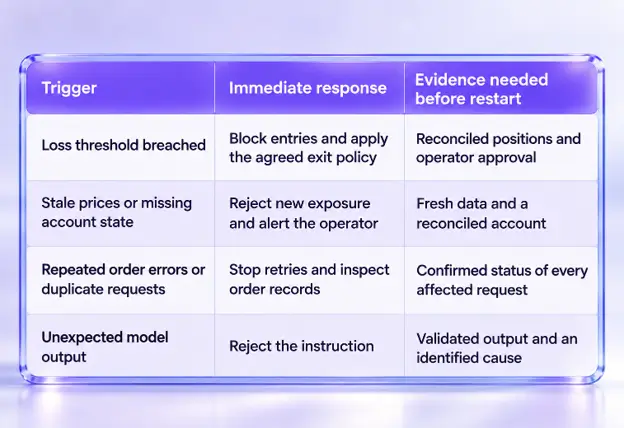
Closing positions comes with its own slippage risk, and it can also fail during an outage. Existing protective orders might add another layer, but stop prices never promise the execution price. A stopped state also has to survive a restart. Without persistent storage, rebooting the agent can quietly hand back the same trading permissions that the emergency action just stripped away.
The drill needs more evidence than a simple notification:
- Every affected terminal, API connection, and remote instance is accounted for.
- Pending orders and open positions are reconciled against server records.
- A named operator approves recovery after the fault has been investigated.
Exposure Can Hide Behind Several Different Symbols
Multiple agents can each stay within their own limit while, together, constructing the same market bet. A gold position, a forex trading position, and an equity index trade might all tilt the same way on interest rates or the dollar.
The Versus Pairs capture the relative performance of two assets inside a single CFD instrument. That setup changes the evaluation the agent has to run. Even a correct forecast that both assets will climb doesn’t tell you which side of the pair comes out ahead.
Contract specifications, trading sessions, and the direction of the relative move all belong in the risk analysis. A position in a relative-performance instrument can also overlap with exposure sitting elsewhere in the account. One symbol doesn’t equal one isolated source of risk.
Position sizing ties the loss budget to the instrument’s contract value and the planned exit distance, after accounting for costs. Leverage sets margin requirements and magnifies both gains and losses relative to committed capital. A small margin requirement doesn’t mean a small potential loss.
Position management doesn’t stop at entry. Portfolio checks can cover gross risk exposure, available margin, and concentration across related risk factors. These risk management strategies matter equally whether an agent runs on machine learning or a plain rule-based trading style.
Model Confidence Cannot Change Trading Permissions
LLM trading introduces a whole different failure path. A model might read a web page or news feed where instructions are buried inside what looks like source material. If that text then shapes tool calls, research content morphs into an unauthorized trading order.
OWASP calls out excessive functionality, permissions, and autonomy as the engines behind excessive agency. Its guidance backs narrow tool access and independent authorization. Brought over to trading, that means an agent’s research tools shouldn’t also have access to withdrawals, credentials, or risk-policy edits.
A structured order proposal hands risk management tools something concrete to evaluate: symbol, direction, volume, price assumptions, and expiry. Missing fields or values outside the approved set get rejected. No amount of persuasive explanation overrides the outcome.
AI models can certainly add insight into market trends or help identify potential risks. Some AI tools can automate risk assessment across huge volumes of risk data. But AI assistance doesn’t erase the need for validation. AI-driven risk management can’t paint an accurate risk picture if the positions or prices underneath it are wrong.
Our piece on building workflows before buying agents shows that operational groundwork matters well beyond finance. In a trading process, the workflow pins down who can authorise orders, who can change limits, and who owns recovery.
Here is where agentic AI in finance runs into a plain access-control question. An autonomous agent can propose actions inside its mandate. That mandate needs an owner who sits outside the agent.
MT5 Deployment Needs a Controlled Handover
An installation guide handles one slice of the rollout. Versus Trade’s walkthrough of where to download MetaTrader 5 for PC covers setting up the Windows platform. Attaching an agent piles on additional decisions about software permissions, account selection, and operational oversight.
An MT5 expert advisor is an automated program, but not necessarily an AI system. AI agents might plug in an EA as an execution piece, while other setups go through external services or Python. Every route needs testing, and an emergency control has to cover whichever routes are live.
MetaQuotes provides a setting to disable automated trading whenever you switch accounts. That matters a lot during a demo-to-live handover, where a previously attached program could otherwise hang onto authority; it shouldn’t have. Model versions, configuration files, and approved limits need to be logged together. Those records help separate faults in AI algorithms from execution failures.
A staged rollout delivers different evidence at each stage. Historical evaluation checks assumptions against past data. Forward simulation tests how the integrated system behaves as new market data arrives. A small live pilot, if you go that route, exposes execution differences using capital the operator can afford to lose. Scaling up permission hinges on predefined acceptance criteria and the operator’s risk appetite.
Vitalii Bulynin, CEO and co-founder, wrote in a public LinkedIn post: “In my experience, discipline and risk management matter far more than trying to predict every market move.”
For automated risk management, that discipline shows up in observable behaviour. Rejected orders stay rejected. Rebooting the software doesn’t wipe away a breach. A model update goes back into evaluation before it gets broader permissions.
Effective risk management keeps that decision outside the model. A pilot that misses its acceptance criteria stays paused.
By Janis Baltalksnis – Versus Trade Regional Director, Thailand & Laos