A model that works in a demo and a model that works at scale are two different problems. The first one just needs to answer correctly. The second one needs to answer correctly at a price the business can live with, every single time someone sends a request.
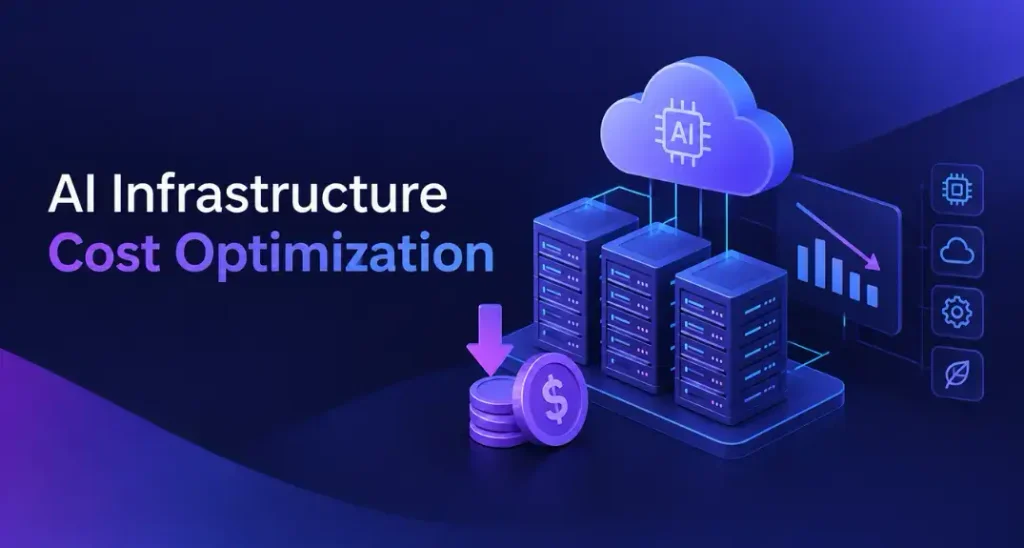
That second problem is where most teams get stuck. AI Infrastructure Cost Optimization has quietly become one of the more pressing engineering challenges of 2026, not an afterthought that finance handles once the invoice arrives. Here’s what’s actually driving the bill up for AI/ML services, and what to do about it.
Why AI Bills Don’t Behave Like Other Cloud Costs
Traditional infrastructure costs scale in ways engineers can predict. Add a server, pay for a server. AI inference doesn’t follow that pattern.
Token-based pricing, uneven GPU utilization, and pricing models that shift by provider and by model version make it genuinely hard to answer a simple question: which feature, team, or workflow is driving this month’s spend?
That gap between predictable cloud costs and unpredictable AI costs is exactly why AI infrastructure cost optimization has become its own discipline rather than a subset of general cloud FinOps.
Across recent industry surveys, the pattern is consistent even when the exact figures vary. AI spend is climbing faster than the infrastructure discipline needed to manage it, and most organizations are still building that discipline after the fact rather than before scaling up.
A poorly structured prompt, an unbounded retrieval step, or an agent that loops on itself can multiply cost across every request that touches it. None of this shows up cleanly on a cloud bill. It shows up as a number that grew, with no obvious reason attached.
The New Cost Risk: Agents That Don’t Know When to Stop
Autonomous agents introduce a failure mode that static models never had. An agent making live decisions, calling tools, and chaining reasoning steps can rack up a large bill in a short window if it gets caught in a recursive loop or keeps retrying a failed call.
This isn’t purely a technical bug. It’s a governance gap. Cost control for agentic systems needs guardrails: hard limits on tool calls per session, timeouts on reasoning chains, and alerts that fire before a runaway loop turns into a five-figure afternoon.
Take a support agent set up to resolve tickets end to end. Without a call limit, a single unresolved ticket can send the agent back through the same retrieval and reasoning steps dozens of times, each pass adding tokens to the bill without moving the ticket any closer to resolved. A cap of, say, five tool calls per session, paired with an escalation to a human after that, catches the failure early and keeps the cost of a bad session predictable instead of open-ended.
Core Engineering Levers for AI Infrastructure Cost Optimization
Once visibility exists, the actual optimization work comes down to a small set of levers, applied consistently.
Model Routing and Right-Sizing
Not every request needs a frontier model. Classification, extraction, and simple summarization tasks can run on smaller, cheaper models, with the expensive model reserved for genuinely complex reasoning.
Pricing gaps between a provider’s smallest and flagship models can run into the tens of multiples, so routing even a portion of traffic downward changes the bill meaningfully.
Semantic Caching
Near-duplicate requests are common in production systems. Caching responses to semantically similar queries, rather than only exact matches, cuts repeat inference cost without touching accuracy.
Retrieval and Chunk Sizing
In RAG pipelines, bigger context chunks aren’t automatically better. Oversized chunks add noise and inflate token counts on every call. Sizing chunks to match actual query patterns reduces both.
Quantization and Compression
For self-hosted models, quantization trades a small amount of precision for a real reduction in compute cost per inference, often with no noticeable drop in output quality for the task at hand.
Batching and Autoscaling
GPU utilization sitting idle between requests is money spent for nothing. Batching requests and scaling infrastructure to match actual load, instead of provisioning for peak, closes that gap.
None of these levers work in isolation, and none of them need to be applied everywhere at once. A team running a customer-facing chatbot might start with routing and caching, since those touch the highest volume of traffic.
A team running batch document processing might get more out of quantization and autoscaling, since latency matters less and raw compute cost matters more. The starting point depends on where the traffic actually sits, not on which lever sounds most impressive on paper.
LLM Infrastructure Optimization at the Architecture Level
Some of the biggest cost decisions get made before a single prompt is ever sent, at the architecture stage.
Self-hosting versus API-based inference is the first fork. Self-hosting can lower per-token cost at real scale, but it adds operational load: capacity planning, patching, and uptime that a managed API absorbs for you. The right call depends on request volume and how much infrastructure work the team can realistically own.
Sparse architectures are changing that calculation. Mixture-of-Experts models activate only the parameters needed for a given task instead of running the full model on every request, which can lower compute cost for the same workload. A closer look at how this plays out in practice for AI inference infrastructure covers the deployment tradeoffs in more depth.
Building an AI FinOps Practice
Visibility and engineering fixes only hold if someone owns the ongoing discipline. That’s what AI FinOps is: treating AI spend the way mature teams already treat cloud spend, with attribution, budgets, and monitoring built into the workflow instead of bolted on after the fact.
Attribution comes first. Cost needs to map to a message, a session, or an agent, not just a total token count at the end of the month. Without that, no one can tell which feature is worth its price tag and which one is quietly bleeding money.
Governance for agentic workloads follows close behind, since these are the systems most likely to produce a surprise. Real-time monitoring, budget caps at the workflow level, and alerts tied to spend velocity, not just totals, catch problems before they compound. This breakdown of AI FinOps walks through what that governance layer looks like when it’s built well.
A Practical Starting Framework
For teams that haven’t approached AI Infrastructure Cost Optimization as a standing practice yet, a workable sequence looks like this:
- Instrument first: You can’t optimize spend you can’t see. Get token and cost tracking attached to messages, sessions, and agents before changing anything else.
- Attribute the spend: Map cost to features and teams, not just a total.
- Route what can be routed: Move simple tasks to smaller models.
- Cache what repeats: Semantic caching and retrieval tuning are usually the fastest wins.
- Govern what acts autonomously: Put hard limits on agent loops and tool calls before scaling agentic workflows.
Teams that treat this as a standing engineering practice, rather than a one-time cleanup, tend to see the largest and most durable reductions. One practical look at moving from token tracking to AI cost optimization for measurable ROI breaks this sequence down with more detail on each step.
When In-House Bandwidth Runs Out
Some of this work is straightforward to implement with existing engineering resources. Some of it, like architecture decisions around self-hosting, building attribution pipelines from scratch, or setting up agent governance at scale, benefits from outside expertise that’s done it before.
Teams weighing that build-versus-bring-in-help decision can look at AI development services built around exactly this kind of infrastructure and workflow design work.
Getting AI Infrastructure Cost Optimization right at the architecture level is usually the highest-leverage place to bring in outside help, since mistakes made there are the most expensive to unwind later.
The Bottom Line
AI Infrastructure Cost Optimization isn’t a line item to review once a quarter. It’s a set of engineering decisions made at every layer: which model answers which request, how retrieval is shaped, how agents are bounded, and who owns the number at the end of the month.
Teams that build these habits early spend less time explaining a surprise bill and more time building the thing the AI was supposed to help with in the first place.
FAQs
1. What is AI infrastructure cost optimization?
AI infrastructure cost optimization is reducing inference, compute, storage, and orchestration costs without compromising the performance or reliability of AI workloads.
2. What drives AI inference costs the most?
The biggest cost drivers typically include model size, token volume, context length, GPU utilization, retrieval overhead, repeated queries, and uncontrolled agent or tool-call loops.
3. How can model routing reduce AI costs?
Model routing sends simpler tasks to smaller, lower-cost models while reserving larger models for complex reasoning. This reduces the average cost per request without forcing every workload onto the same model.
4. What role does AI FinOps play in cost optimization?
AI FinOps helps teams attribute spending to specific models, features, agents, or workflows, making it easier to set budgets, monitor anomalies, and identify inefficient workloads.
5. Is self-hosting AI models always cheaper than using APIs?
No. Self-hosting can reduce per-inference costs at sufficient scale, but it also introduces GPU, capacity planning, maintenance, monitoring, and operational costs. The better option depends on workload volume and infrastructure maturity.